
I get the same question almost every week from Aurora homeowners: should I replace my old tank with another tank, or switch to tankless? There’s no one-size-fits-all answer, but there is a right answer for your home, your water usage, and your budget. As a plumber who handles water heater installation in Aurora every week, I’ve put together real, local numbers instead of national averages, so you can make this call with confidence.
In This Article
- How Tankless and Traditional Water Heaters Work
- Water Heater Installation Cost in Aurora: Tankless vs Tank Pricing
- Energy Efficiency and Monthly Savings
- Lifespan and Maintenance: Which One Lasts Longer
- How Aurora’s Hard Water Affects Your Water Heater
- Which Water Heater Is Right for Your Aurora Home
- Colorado Rebates and Tax Credits
- Frequently Asked Questions
How Tankless and Traditional Water Heaters Work
A traditional water heater stores 30 to 80 gallons of water in an insulated tank. It heats that water and keeps it warm around the clock, whether or not anyone’s using it. When you turn on the hot tap, water already sitting in the tank flows out.
A tankless water heater skips the tank entirely. Cold water passes through a heat exchanger and gets warmed instantly, on demand, using a gas burner or electric coils. Nothing sits around waiting to be used, and nothing sits around losing heat.
That one design difference explains almost every advantage and drawback you’ll read about below.
Water Heater Installation Cost in Aurora: Tankless vs Tank Pricing
Upfront cost is where most homeowners hesitate. Here’s what Aurora water heater installation typically runs, based on unit type, fuel source, and installation complexity.
| Feature | Traditional Tank | Tankless |
|---|---|---|
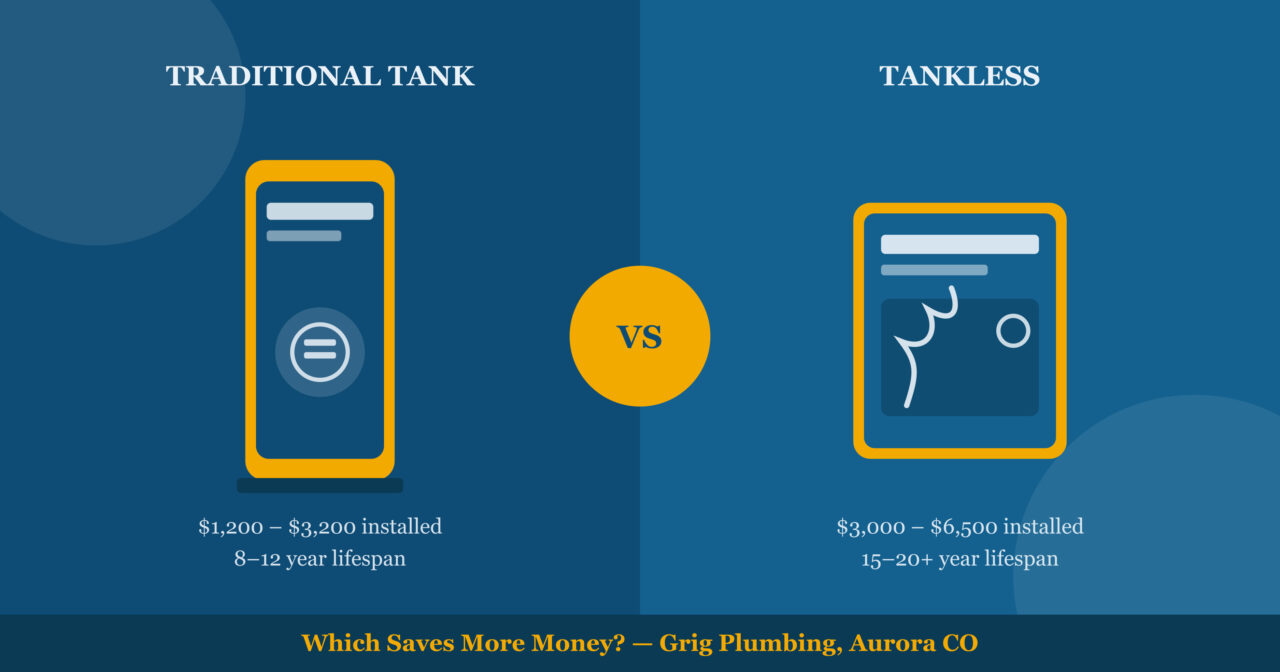
| Installed cost (gas) | $1,200–$3,200 | $3,000–$6,500 |
| Average lifespan | 8–12 years | 15–20+ years |
| Annual energy savings vs. baseline | Baseline | 24%–34% lower* |
| Space needed | 16–20 sq ft, dedicated area | 2–3 sq ft, wall-mounted |
| Hot water supply | Limited to tank size | Continuous, limited by flow rate (GPM) |
| Maintenance in Aurora’s hard water | Annual tank flush recommended | Annual descaling required |
| Best for | Tight budgets, short-term ownership | 7+ year homeowners, high hot water demand |
*Homes using 41 gallons or less of hot water per day see the full 24–34% range; larger households still see 8–14% savings, according to U.S. Department of Energy figures.
Installation complexity drives most of that price gap. A tankless retrofit often needs a larger gas line, upgraded venting, or an electrical panel upgrade for electric models — Aurora homes built before the 2000s especially. A straight tank-for-tank swap, by comparison, usually reuses your existing connections.
Not sure which unit fits your Aurora home’s plumbing and gas line?
Call (983) 218-4929 for a Free Estimate
Licensed & insured — serving Aurora, CO with fast, same-week scheduling.
Energy Efficiency and Monthly Savings
Traditional tanks lose energy just sitting there. Reheating water that’s already cooled off between uses is called standby heat loss, and it’s the single biggest reason tank heaters cost more to run every month.
Tankless units skip that loss entirely because nothing sits pre-heated. For an average Aurora household, that typically means $100 to $200 saved per year on a gas tankless system, or $50 to $100 with electric. Over a 20-year lifespan, that adds up to $2,000–$4,000 in energy costs avoided.
Aurora sits at roughly 5,470 feet in elevation, and colder incoming groundwater temperatures in winter mean your water heater — tank or tankless — works harder from November through March. This makes correct sizing especially important here; an undersized tankless unit will struggle to keep up with two showers running at once during a Colorado winter.
Lifespan and Maintenance: Which One Lasts Longer
Traditional tanks last 8 to 12 years on average. Tankless units routinely reach 15 to 20 years, sometimes longer, because there’s no tank to corrode or leak.
Both systems need upkeep, but the type of maintenance differs:
- Tank heaters need an annual flush to clear sediment and an anode rod check every few years to prevent corrosion.
- Tankless units need annual descaling to remove mineral buildup inside the heat exchanger — a step that matters more in Aurora than in most cities, which we’ll cover next.
How Aurora’s Hard Water Affects Your Water Heater
This is the part most water heater guides skip, and it matters if you live here. Aurora’s municipal water tests as “very hard” — generally in the 11 to 15 grains per gallon range depending on your neighborhood and source. That’s roughly two to three times the national average.
In a traditional tank, hard water minerals settle as sediment at the bottom, which insulates the burner and forces it to work harder. In a tankless unit, those same minerals scale onto the heat exchanger, which can restrict flow and reduce efficiency if it’s never flushed.
The fix isn’t complicated: schedule an annual flush or descaling visit, and consider pairing either system with a whole-home water softener. It’s one of the easiest ways to protect your investment and keep either unit running at full efficiency for its full lifespan.
Which Water Heater Is Right for Your Aurora Home
There’s no universal right answer here, but a few honest guidelines help:
- Choose tankless if: you’re staying in your home 7+ years, your household regularly runs multiple hot water fixtures at once, or lower monthly bills matter more than upfront cost.
- Choose traditional if: you’re on a tighter budget, need a fast same-day replacement, or you’re in a rental property where recouping the upfront cost over time isn’t a priority.
If you’re not sure which category you fall into, a quick walkthrough of your home’s gas line, panel capacity, and household hot water habits usually settles it in a few minutes. That’s the exact evaluation we run for every water heater installation in Aurora we quote.
Colorado Rebates and Tax Credits
Colorado homeowners have real money on the table right now. Xcel Energy’s Clean Heat Plan currently offers rebates toward qualifying heat pump water heaters, and the federal Energy Efficient Home Improvement Credit can cover a portion of qualifying tankless or high-efficiency installations . Because these programs are updated on a rolling basis, confirm current amounts with ENERGY STAR’s federal tax credit page or ask us directly when we quote your job — we stay current on what’s available.
Frequently Asked Questions
Which lasts longer, a tankless or traditional water heater?
Tankless units generally last 15–20 years, sometimes longer with regular descaling. Traditional tanks typically last 8–12 years because the tank itself corrodes over time. That extra lifespan is a big part of tankless’s long-term value.
Is a tankless water heater worth the extra upfront cost?
For most Aurora households staying 7+ years, yes. Energy savings plus a longer lifespan typically offset the higher installation cost within 8–12 years, then continue saving money after that.
Do tankless water heaters work well with Aurora’s hard water?
Yes, with maintenance. Aurora’s hard water causes mineral scale buildup faster than in most cities, so tankless units here need an annual descaling to keep running efficiently and avoid flow restriction.
Can a tankless water heater run out of hot water?
Not in the way a tank does, but it can be overwhelmed. If you run more hot water fixtures at once than the unit’s flow rate (GPM) supports, output drops. Correct sizing during installation prevents this.
How much does water heater installation cost in Aurora?
Traditional tank installation typically runs $1,200–$3,200. Tankless installation runs $3,000–$6,500, mainly due to gas line, venting, or electrical upgrades many older Aurora homes need.
Are there rebates for water heaters in Colorado?
Yes. Xcel Energy offers rebates on qualifying heat pump water heaters, and federal tax credits apply to some high-efficiency units. Amounts change yearly, so confirm current figures before you install.
How long does water heater installation take?
A straight tank swap usually takes 2–4 hours. A tankless installation typically takes 6–10 hours, longer if gas line or electrical upgrades are needed.
Get a straight answer for your Aurora home — no upsell, just the right unit for your household.
Licensed, insured, and local to Aurora, CO. Ask about current water heater installation availability.
About the Author
Grig Plumbing is a licensed and insured plumbing contractor serving Aurora, CO and the greater Denver metro area for 3 years. We specialize in water heater installation and replacement, handling both tank and tankless systems for homeowners across Aurora’s neighborhoods.